
When Feng Shui and Interior Design Work Together — What Actually Changes
"If you want to find the secrets of the universe, think in terms of energy, frequency and vibration."
— Nikola TeslaYou don't have to believe in Feng Shui for it to affect you.
You've walked into a room and felt heavy for no reason you could name. You've sat in a café and felt immediately at ease. You've worked at a desk for months and felt stuck — not in your work, but in yourself. You've visited someone's home and wanted to stay for hours, then left wondering why your own living room never feels that way.
Energy in a space is not mystical. It's the accumulation of light, airflow, proportion, layout, and materiality — the way a room breathes, or doesn't. Tesla wasn't talking about interior design when he wrote that, but he was describing exactly what Feng Shui has been mapping for thousands of years: that everything vibrates, and that the frequency of a space affects the people inside it.
What Feng Shui actually reads
Feng Shui — specifically the San Yuan Xuan Kong Fei Xing system, known as Flying Stars, which is the methodology we use at Dezainteria — is not about placing a lucky bamboo plant by the front door. It's a method of reading the energetic quality of a space based on its orientation, the year it was built, and the movement of energy across its different areas over time.
Some areas of a space will carry energy that supports focus and clarity. Others carry energy that creates friction, fatigue, or stagnation — not because something is wrong with the design, but because of how energy moves through that particular configuration at this particular time.
The analysis identifies what is happening energetically in each area, and what that area needs.
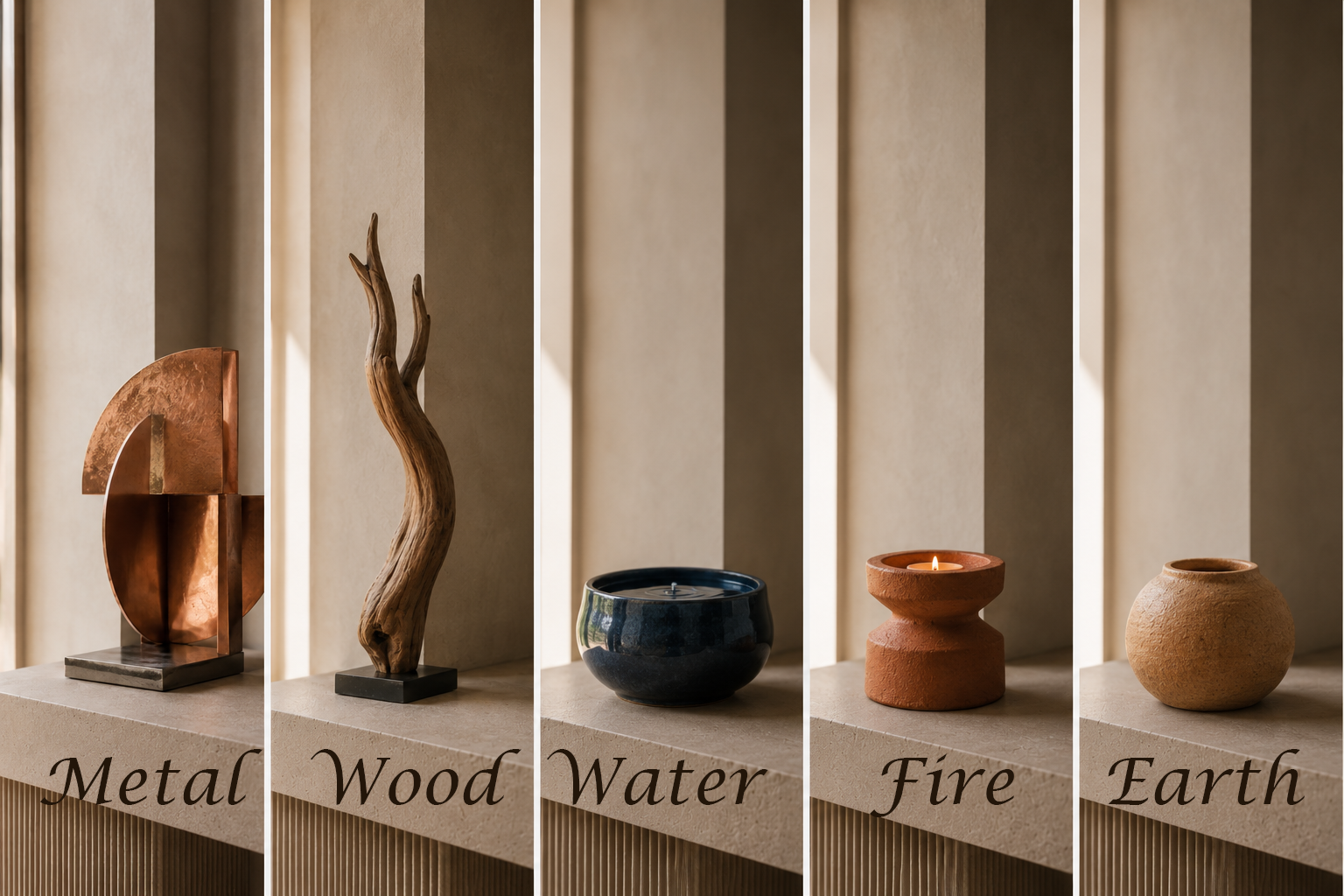
The five elements — wood, fire, earth, metal, water — each carry a distinct energy quality. Feng Shui identifies which elements a space is missing or has in excess.
Where design comes in
This is where interior design becomes the delivery mechanism.
If an area needs metal energy — to sharpen focus, reduce scattered thinking, or introduce clarity — you bring in metal. Not randomly, but intentionally: a copper sculpture, a steel-framed mirror, metallic hardware on a cabinet. The specific object matters less than the element it introduces into that part of the space.
If an area needs activation — to move stagnant energy — you introduce light or movement. A wall light in a dark corridor. A tabletop fountain in a home office. A plant with upward-reaching leaves in a room that feels flat.

Metal and wood elements expressed through everyday objects — the intervention becomes part of the design, not an addition to it.
The difference between a Feng Shui consultation and Feng Shui as part of interior design is exactly this: a consultation tells you what the space needs. Design builds it in — so the intervention becomes part of the space rather than an object placed on top of it. You would never look at the room and think "that's a Feng Shui fix." You would just feel that the room works.
What this looks like in practice
In one residential project we worked on, the family noticed they felt fine everywhere except at home. Not unhappy — just heavier. More fatigued. Less themselves than when they were outside. The apartment was well-designed. Nothing was visually wrong with it.
The Feng Shui analysis showed several areas carrying energy that needed adjustment: a south-facing zone that needed activation, a corridor that was blocking rather than moving energy through the apartment, a home office where the desk was positioned against the energetic current of the room.
The interventions were specific. Directional lighting in the corridor. Two metal artwork pieces on the walls. A repositioned desk. Plants and a focused light source in the south-facing area. A small water feature for the office.
None of it looked like "Feng Shui." It looked like considered design choices — because that's what they were.
Some months later, the family said the apartment felt different. Not dramatically. Just lighter. More like them.
A Feng Shui consultation with Dezainteria covers the complete assessment: orientation reading, Flying Stars analysis, and an in-person site visit. If you're also planning a design project, the two processes work together from the start — the Feng Shui informs the design rather than being layered on after.
Every project starts with a free consultation call. If we move forward, the site visit fee is fully credited toward the design fee.
Book a Free Consultation +961 70 860 181